DING Jian Han reflects upon his experience at Ding Yi Music Company’s Composium 2021, and receiving first prize (Category B2) and Young Singaporean Composer Award for his work Lu(Nox)!
Contributed by DING Jian Han
My experience in this year’s Composium by the Ding Yi Music Company has been nothing short of amazing. I have learnt so much about Chinese chamber music and instruments, and also just about composition in general. I would like to break down my reflections into some of the individual events I participated in:
Recording Session as Symposium Speaker – “Composition Competition: Thematic vs Free Writing”
This recording was done while I was still in Germany. This was actually the first time I got to see all the nine finalists (albeit through Zoom). It was nice being able to interact a little with them before the recording started and observe their personalities and characters. I was amazed by the fluency and maturity of their thoughts regarding the topic. Having to formulate a decent response for this symposium was quite challenging, but I am glad I was able to do it despite my lower standard of Mandarin as compared to other finalists. This topic was also rather interesting as it is very relevant to us composers, and in my opinion, even more so when we compose for a gig or commission.
Open Rehearsals
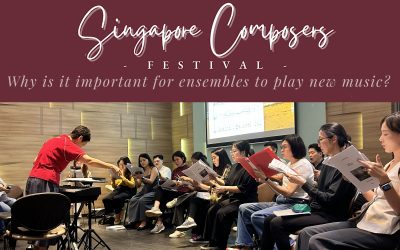
This is really a unique feature of the Composium. I may be wrong, but most composition competitions do not have such a segment. Watching the Category A open rehearsal on the first day really geared me up for my own open rehearsal on the second day. I must say it was fantastic to finally hear the music of my fellow finalists and to witness their various rehearsal styles. Everyone was given a fixed 20 minutes and it was interesting to see how almost everyone took a different approach to this time limit. Being able to work with the amazing Ding Yi musicians and conductor Mr. Quek Ling Kiong during this session was so valuable. I could hear my compositional ideas come to life and be able to communicate with the ensemble to further improve my piece. The invaluable advice and comments offered by the esteemed adjudicators were very important to my learning experience as well. The pointers given to me by Mr. Eric Watson and Prof. Chen Yi are things which I can consider in my next pieces for Chinese chamber ensemble. I must say I was quite nervous during my rehearsal, partially due to the fact that the rehearsal process was graded and it was conducted in my weaker language. However, I am glad that the points for improvement that I noted were communicated quite effectively in the end, and although there were things which I felt I could have conveyed better, I am overall quite satisfied with my open rehearsal.
Symposiums: “Compositional Devices of Western vs Chinese Music” & “What’s Next for Chinese Chamber Music”
The first of these two symposiums featured established Singaporean composers Mr. Eric WATSON, Dr. GOH Toh Chai, Ms. Jon Lin CHUA, and Ms. Alicia DE SILVA, with PHANG Kok Jun as host. I found this session really insightful. There was a general consensus amongst the panel that polyphony is very much ‘translatable’ from Western to Chinese music as the individual colours of the instruments are so distinct. Klangfarbenmelodie, something which I enjoy using quite a lot in my own music, was also brought up as its effect is arguably even stronger in Chinese ensembles due to the many different sound colours available and different tunings (some instruments are well-tempered while others like Dizi are more naturally tuned because of the half-holes for chromatic notes). There was another point mentioned which I found really interesting – techniques to aid translating some of the ornamentation and other inflections found in Chinese folk or Classical traditions to score. In such cases, it may not be so effective to notate them with all the microtones, precise nested rhythms, and other examples of ‘Western extended notation, “but rather to use a text” in the style of to appeal to the performer’s knowledge of performance practices. An analogy that was raised to illustrate this point was the example of using performance instructions like “light swing” in a jazz-inspired piece, instead of attempting to fully notate the nuances of swing through complex rhythms and changes in dynamics or accents. In addition, it was suggested that a composer could even create a QR code and put it in the score to direct the performers to a video link, where they can hear exactly what you are trying to achieve as the composer.
The second of the two symposiums, which featured the adjudicators of the competition, was also really interesting. As a participant of the competition, I was very curious to hear what they had to say about Chinese chamber music, which is truly a fascinating instrumental genre. They talked about the effects of the global COVID-19 pandemic on Chinese orchestras and hence the emergence of small chamber groups; although this has already been a trend in China for quite a while. There was also some discussion about how the influence of Western chamber ensembles and even the emergence of East-West fusion ensembles (like in Germany) impacted the growth of Chinese chamber music. The panel emphasised a great deal on education and outreach for this emerging instrumental genre and I could not have agreed more whole-heartedly.
Masters’ Replay Concert
This concert was an absolute feast for the ears! The best thing about the concert was how wonderfully diverse the pieces were – from a brilliant mix of traditional Chinese elements and contemporary Western compositional techniques in the first two pieces by Prof. WANG Jian Min and Prof. CHEN Yi ( Dance of the Naxi Tribe and Three Dances from China South respectively), to a masterful piece where different musical objects exist on their own time planes by Prof. QIN Wen Chen ( The Sun Shadow VI ; I really loved this piece), to a masterclass in compound sound, textural and spatial writing, coupled with innovative use of technology at the end of the piece by Dr. CHONG Kee Yong ( Heart Bridge ), to a brilliant imagery of the Singaporean landscape and homage (to my ears) to Jazz elements which were so compelling by Mr. Eric WATSON ( Promenade ), and finally to a more film score-like piece by Mr. LAW Wai Lun ( River of Life-Chapter Two : A Prosperous River ) which has such captivating and beautiful melodies, and made me think of many of my favourite film scores, as well as the beauty of my own homeland.
Prize Presentation Concert
After that short and sweet concert in the afternoon, it was finally time for all of the finalists’ pieces to be premiered! I am not going to lie, I was certainly very nervous leading up to the performance of my piece, Lu(nox). Many thoughts ran through my head like “Did I do enough during the rehearsal?”, “Is it going to sound very different from what I heard yesterday (especially due to the nature of Zoom), or what I envisioned?” “Will I like it?”. Before we get to my piece though, I must say I was thoroughly impressed by the music of my peers. They were so successful in merging traditional Chinese elements (be it from a particular culture or a “traditional type of sound”) with their own compositional style. Some went for a more melodious approach with beautiful harmonies, some had such fascinating use of colours and imagery, and others created an imaginary world with a myriad of techniques and textures. I actually felt that my piece was not that “Chinese” sounding, besides the fact that I used Chinese instruments and one segment of the pitch row I used in the piece had the pentatonic scale. Instead, I drew inspiration from the sounds and textures which I have learnt and so love from the great European avant-garde masters (Helmut Lachenmann being the biggest influence in this particular piece), and provided them a context within the realm of Chinese instruments, whose sound colour I have adored greatly since I was a child.
I truly enjoyed the performance of my piece and realised that quite a number of things which I had envisioned actually came through to a great effect! There were some pleasant surprises as well, which is always nice for a composer. However, being a composer, there were also things which I was critical of in my own writing and it was a wonderful lesson for me. For future pieces, be it for Chinese chamber ensemble or other instrumental combinations, I would be able to tap into this experience and create an even more fulfilling sonic result.
Truth to be told, I did not expect to be awarded the first prize for the B2 category, but I am truly honoured and happy that my work received recognition from such esteemed composers in the adjudicator panel. This may sound strange, but as much as I enjoy winning, I was most happy from the fact that my piece had the opportunity to be performed, especially in a tough time like the present. Such performances ultimately allow one to constantly grow as an artist. I also feel blessed that my music is able to be heard by a large audience and I am so glad for the kind feedback given to me about the piece. I have learnt so much more about Chinese music and Chinese instruments, but most importantly, I have learnt so much more about myself as a composer.